
This single momma hen is also a working professional. I’ve worked at the same institution (my undergrad alma mater) for over seven years now, and I’ve moved from an entry level recruiting position into a director-level role. I don’t say that to brag – I say that to share that I have learned a lot from being a relatively recent new professional and then hiring and training many recent college graduates.
I hope that some of the things I’ve observed in my almost eight years of professional, fulltime work, and approximately six years in supervisory roles, will be of help to you.
These are just seven simple items that will help you look composed, organized, successful, and professional on the job.
#1: Make and manage your to-do list.
How in the world can you say you’ve had a productive day if you didn’t measure it from beginning to end? How can you end the work week and say you feel accomplished?
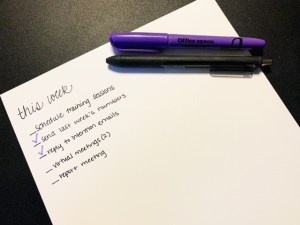
I always start every work week by coming up with achievable, priority goals. I even ask my recruiting team to send me the same; every Friday, they’re expected to send me their 4-5 achievable goals for the next week. As their supervisor, this lets me do two things: 1) see how busy they are so I don’t try to over-delegate tasks to one and under-delegate projects to another, and 2) let me know where they are focusing and offer re-directional coaching if needed.
For my own goals, I tend to write down larger, over-arching projects that must be done by the to-do list end-date (either today or this week).
Giving myself clear priority goals helps me make sure that these are the items that are done – but it also allows for time to accomplish those smaller items, like a surprise walk-in visitor that needs to be assisted or phone call that absolutely needs to be taken.
The particulars of your to-do list don’t matter. If you like color coding in your printed daily planner, great. If you like using the calendar app on your phone, awesome. If you simply have a yellow legal pad with your to do list jotted down in sharpie, that’s fine too. If a white board is up in your office, go for it. Whatever works for you, that is systematic and easy to replicate each time you start a new day or week, is what you should continue doing.
Don’t forget – check off or highlight each completed task as you complete them. It’ll make you feel accomplished!
#2: Dress for success. Look like an adult, not a preteen.
If you are working a professional-level job, even if it’s not your dream job or the end-goal, dress like a professional. You were hired because you projected the impression that you could handle this work – that you had the abilities and the level of competence to get this work done, and that means looking the part too. You likely dressed up for the interview, so don’t slack off now.
I read once that we should all dress for the job we want, not the job we have. That means that we’re not walking into a “Netflix and chill” scenario, so no jeans unless approved by the supervisor, no graphic tees (yes, even tucked into a cute skirt or pair of dress pants, ladies – and yes, even if it’s under a half-buttoned button down shirt, fellas), and no off-brand (or on-brand, for that matter) Ugg boots, for crying out loud.
If it’s a dress down day, don’t feel bad asking your supervisor what’s okay and what’s not. I’d much rather be asked what the appropriate shorts-length is for a Saturday team bonding experience is than to see your butt cheeks all day.
Dress professionally. If you are doubting that it’s professional, go with your gut and wear something else. (And yes, that includes your ties that have cartoon characters on them, gentlemen.)
As a side note: If you have a nametag, it goes on the right side of your shirt.

#3: Know how to appropriately use Outlook features.
It’s likely that your organization uses Outlook. If not and you’re using another resource, like Gmail, replace every use of “Outlook” with your resource’s name.
First off, read receipts are the worst invention ever. They are straight up annoying. Why do you, as my colleague and not my supervisor, need to know if I read the email you sent? Also, even if you are my supervisor, what if I’m not ready to reply yet because I’m trying to allot the appropriate amount of time to answer fully? Maybe I’m swamped and can’t devote the time right now to get you the detailed answer you need. What if I’m mad about what you sent, and I need some time to mull over and respond respectfully? Using “read receipts” is a surefire way to get marked off of your coworker’s Christmas card list. Don’t use them.
Second, please understand how to check your coworker’s outlook calendars (or google calendars) before you schedule a meeting. Conflicts arise and can’t always be avoided, but if you’re leading an event or project, and you schedule a meeting when everyone else has other meetings on their calendars, that’s on YOU as a poor project manager. Pick the time you have available that has the least conflicts – and then make sure to save notes for the folks who do have conflicts so you can catch them up to speed.

#4: Learn the basic rules of grammar – and apply them all the time, not selectively.
You would not believe how many college graduates I hire or interview that don’t use proper grammar in written communication. If you are representing an organization, I assume that that organization wishes for you to project an image of authority and education.
First and foremost – read everything you send BEFORE you send it. If you need a second set of eyes, that’s okay – make a friend at work or, if you have a boss that appreciates coaching and mentorship, you can ask them to review some items occasionally, too. As a supervisor, I want to know when my staff members are trying to improve and want to offer help, so knowing that someone sees this as a professional weakness but wants to grow is incredibly important to me. I’ll make the time to quickly review and offer my edits and suggestions.
If you are not a grammar wizard, that’s okay! There is a really simple solution. Simply type everything you’re planning to send out of your email or messaging system in a Word document first – and make sure your spell and grammar check functions are on. Trust the squiggly lines to correct you. While Word isn’t 100% on the nuances of the English language and might try to tell you to stop using contractions when you actually DO want to us them, you’re likely to have 90%+ success with this method.
If you’re struggling beyond that, there are a TON of books available that focus on improving your business writing skills. Just check out amazon using key words like “business writing” and “improvement” or “help.”

#5: Ask questions about expectations and policies, and then meet them.
What does your supervisor consider a job well done? How do your departmental goals fit into the overall goals for the company? What processes exist that need to be taken for requesting time off, submitting project results, or in preparing for team meetings?
Y’all might not believe this, but out of the over ten folks I’ve either helped train or hired myself, a sold 3-4 of them have had NO idea that you are supposed to REQUEST your time off, rather than just take it whenever you please without supervisor approval. (I hope y’all knew that, too.)
There is likely a formal process for things like requesting personal time off (also called PTO in the business world), for alerting your supervisor when you need a last-minute sick day, or for scheduling adjustments. Ask your supervisor for their preferred method of PTO and sick time requests – then, follow that instruction.
You may also think you’re doing a great job in your role, but you may feel like your supervisor thinks differently. Schedule a fifteen-minute sit down with your boss and ask them directly what things are required to be seen as “meeting expectations” in your role. DO this BEFORE your annual performance review so you have time to excel in your role. IF you’re starting a new job, the way I’d ask this is two-fold: 1) “What are the top three objectives of my job?” and 2) “What are the characteristics of a successful [position title]? How will you measure those on my evaluation?”
It will help you to know exactly what your supervisor expects. Without knowing expectations, you can’t meet them – and you certainly can’t exceed them.

#6: Find your why – and remind yourself of it every day.
There is a reason you took this job. What is it?
Maybe the job provides you with fulfillment – that’s awesome. If so, you buy into the mission of your organization so much that it brings you personal joy and contentment to do the job! That’s a total win.
Maybe the job has amazing healthcare benefits for your family. If so, then keep on keepin’ on, because that is rare in a capitalist world that prioritizes work outcome over family care.
Maybe the job is providing a great schedule or PTO for you and your home life. This is a big why for me in my current job. I get off of work at 4:30 PM – that’s an extra half hour (or more) with my kiddo than many working adults get. On top of that, I get two weeks of vacation days and a few personal days, and I can use my sick time for my dependents, so if my toddler needs to go to the doctor, I can use my sick day for that appointment. Because I serve a faith-based institution, I also get a wonderful Christmas break and a four-day weekend for Easter, and I treasure spending those religious holidays with my family.
There a ton of reasons why you might love or appreciate your job – why you continue to plug away at your to-do list even when you’d rather be in your pajamas watching Hallmark Christmas movies in October, why you vent about your boss but then turn around and hand him a report that exceeds expectations, why you want to turn on snooze on your alarm but get up out of bed and get ready.
Why? What’s your motivation? Make note – stick the picture of your family on your desk. Pin up an encouraging note from your coworker or a thank you note from a customer. Save that email from your boss that says you did great work on your last solo assignment.
Remind yourself frequently that your work provides something (or lots of somethings) that make your effort worthwhile.

#7: Declutter and organize your workspace regularly.
Be honest: what does your desk look like right now? Is it a hot mess express? Or is it organization central?
Mine gets cluttered up by the end of each week. It’s important to clear off the nonessentials (or the items that don’t make your workplace productive or happy) and file them for future needs. Give yourself a few minutes each week (either at the start of the day Monday or last-thing on Friday) to clear off your desk and get prepared for the week ahead. It’ll be well worth the five or so minutes you spend.
Clean workspace, clear mind.

I hope that this was helpful! I’d love to hear some of your on-the-job success tips in the comments below.
 Kate with a Twang