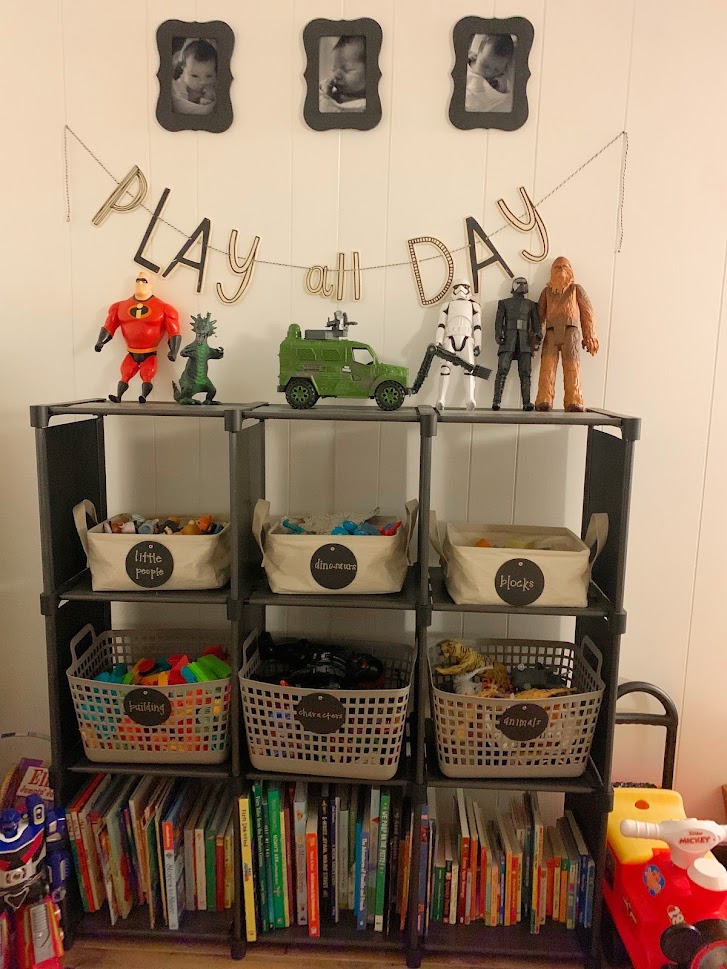
So who knew that being a parent meant that your entire life would be invaded by toys? Some of them are expensive – the “must have” Christmas gift kind of items. Some of them are educational like color-coded puzzles and books that use the alphabet strategically. Some of them are less significant toys – dollar tree prizes for going in the potty or drive thru meal toys, which, for some reason, become so significant to our toddlers that if you misplace it – or heaven forbid get rid of it – you are sure to be reminded of it for the rest of your life.
They. Are. Everywhere.
It’s like Toy Story up in this joint. These things look like they have a mind of their own and are running a miniature toy village when we aren’t looking, am I right?
So we’ve got to get it under control. And the best way I have found to control the toy-a-palooza is to have a system for storage that works. It’s got to work and make sense to you and your family.
So I’m going to share that today.
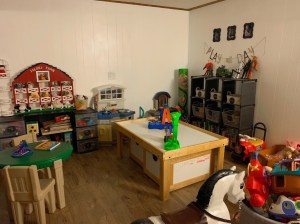
We are very fortunate in the new house to have a full basement. My dad, Jake, and his dad worked really hard to finish it out. (I’ve talked about that in a few other posts – you can see our work out corner and my office in other blog posts.) A larger corner of the open den/family room space is designated as the playroom. This is little man’s space to play with the majority of his toys – but, because it’s open to the rest of the family room area, it needs to be easy to tidy up if we’re having people over or during weekly cleaning times.
So I’ve developed a system that has proven to be fairly useful. I hope it’ll be useful to you, too!
Even if you don’t have a designated play room or corner, I think that these tips and tricks can be applied to your shared family space, living room, or kids’ bedrooms.
#1: Categorize It All
A mistake I’ve made in the past is saying “I don’t know where this goes.” EVERYTHING has a place – or it should!
I think it’s important to take a sort of inventory of your kid’s toys and to make mental categories. They can be as general or specific as works for you and your child’s interest. Here are some of our categories:
- Little People
- Dinosaurs
- Blocks
- Building
- Characters
- Animals
It’s easy to say “okay, all of the toys that are Little People brand go in here,” but I also needed a spot for “characters” because we have a lot of specific character toys – Mickey and friends, The Incredibles, Star Wars, Spider-Man, Paw Patrol. Those kinds of character-specific toys go in the “character” bin. In your house, those might be combined into an “action figure” bin, for example.
Having a mental list of categories for all of the toys means that I have a “home” designated for each item – that they will have a place and not be a “floater.”
It also means it’ll be easy to group similar items quickly for a last-minute clean up job.
Bonus Tip: If you find you have a lot of these floating, no-home items, you can always create a miscellaneous bin – but I would suggest going through it regularly to see if a new, more permanent home makes sense for an item in the future.
#2: Invest in Storage Items
You can’t have a storage system without storage tools. They don’t have to be what I used – in fact, I’ll give you a couple different ideas here outside of what I utilized.
Think about what you have and how big your storage containers need to be. Do you need small storage, medium storage or large storage? Do you need a combination of these sizes?
Here’s another big question: do you like lids or no lids? Do you prefer drawers or baskets or lidded chests?
For my family, we have a mixture. I prefer no lids – personally, I feel it creates a barrier between mess and tidy, an extra step to lift or remove a lid that doesn’t seem helpful to my son if he’s helping pickup. I prefer open bins/baskets and drawers.
In our play corner, we have a combination of storage systems, and they all work for their purpose.
For our train and activity table (gifted by some very dear friends), we have two rolling under-table storage bins that hold Hot Wheels cars and track supplies and wooden train table accessories respectively.
We also have a cube shelf (purchased on Amazon here) that stores books and toys, labeled with tags, plastic storage that stores specific categories of toys, and a shelf for puzzles and games.
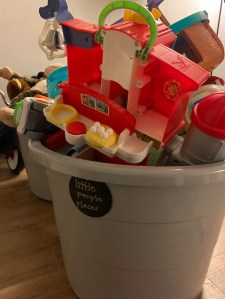
For larger items like stuffed animals, Little People houses and other places, and transportations, and mega blocks, we have larger labeled bins. The art section is a unique area where we actually have a storage cart and various art supplies.
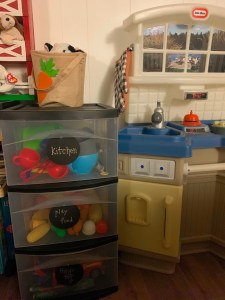
We also have an open shelf for puzzles and plastic see-through drawers for several items like play kitchen supplies and food, costumes for dress up, or miscellaneous cars and tractors and trains (AKA “things that go”).
Using more open-concept storage systems is helpful to me so I can see where things go – and my son can see where things go to return them as he helps with clean up.
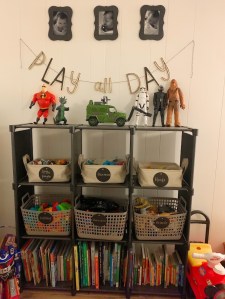
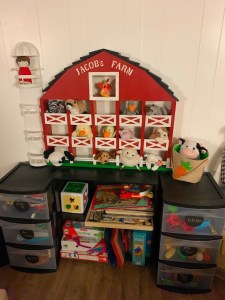
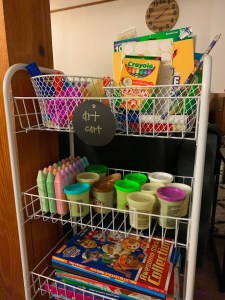
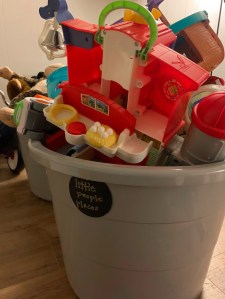
#3: Labels are Your Friend
I think my toddler is pretty smart – but he’s not reading yet. So why use the labels?
Well, for starters, he WILL be reading soon, and it’s important he starts to understand that there are words associated with specific items.
But labels are also helpful for tired mommas. If you are like me, there are days when you can barely remember how to spell your own name, let alone remember which bin the Chewbacca toy goes in. The labels can be a lifesaver.
Jake is also new to this parenting thing – and to my style of organization. He’s such a helpful partner and future stepdad, and I’m so grateful when he jumps in and helps without even being asked. Having a labeled system helps him get familiar with how I organize and where everything’s “home” is.
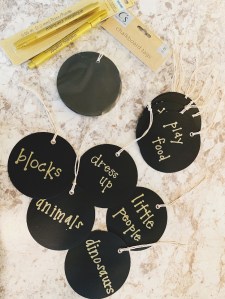
I got my labels and gold marker pen all at Dollar Tree. I wrote on the labels with a fun, simple font and then got glued them to the appropriate container.
Pro Tip: Don’t add the labels right away. Pick up a few times first and make sure your categories work before you hot glue labels to the bins.
What do you think? Do you already employ some of these tips in your kiddo’s play space or bedroom? What additional tips to do you have? I’d love to hear from you in the comments!
 Kate with a Twang
Great idea for the play kitchen storage!
LikeLiked by 1 person
Thank you so much!
LikeLiked by 1 person